Reframing Indian Luxury: How Fashion, Beauty, and Market Power Are Converging
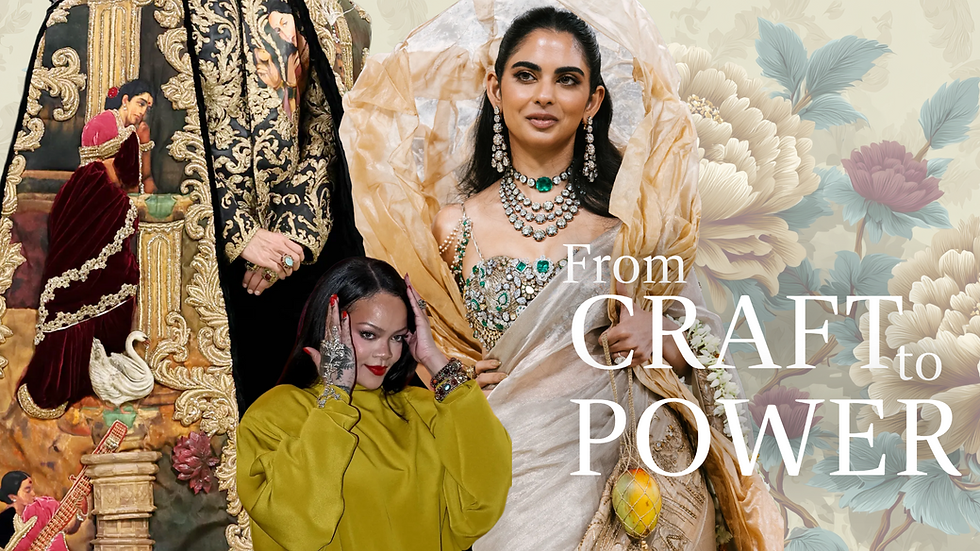
I’ve been pondering upon the Met Gala since yesterday, not for the spectacle but for what it clarified.
For a long time, Indian presence in global fashion has been discussed through the lens of representation. We tracked who attended, who wore what, and how often Indian references appeared on international platforms.
This year felt different.
It wasn’t about visibility. It was about control over how Indian aesthetics were framed within the language of luxury.
And that distinction is important.
Craft Without Explanation
What stood out across multiple appearances was a shift in how Indian craft was positioned.
With Isha Ambani, the craftsmanship was undeniable. The level of surface detail, the labour behind the embroidery, the density of material choices all pointed to the scale of artisanal involvement.
But none of it was over-explained.
The sari held structure. The styling was restrained. The jewellery, particularly heirloom pieces, was not treated as an accessory layer. It was integrated into the garment itself, almost functioning as construction. A blouse embedded with stones reframed jewellery from ornamentation into design.
That shift signals a different kind of confidence.
The craft did not need validation. It was already assumed.
When Cultural References Become Design Language
Karan Johar’s appearance made this even clearer.
The reference to Raja Ravi Varma could have easily remained illustrative. Instead, it was translated into a fashion context. The cape carried scale and narrative, but it was anchored in a sharply controlled silhouette.
The reference was present, but it was not didactic.
Indian art and cultural history are being treated as creative material. Something to build with, not something to explain.
The Quiet Scale of Artisanship
Behind these looks sits an ecosystem that is often overlooked.
Artisans from across India, including clusters in Rajasthan working on forms like pichwai, continue to be central to the creation of these garments. The level of detail and time invested remains unchanged.
What is shifting is how their work is framed.
The emphasis is moving away from process-led storytelling toward outcome-led perception. The value is communicated through the finished garment rather than through the narrative of labour behind it.
This is not a reduction of craft.
It is a repositioning of it.
Editing Heritage for a Global Lens
Even in appearances connected to legacy and lineage, such as members of The Royal Family of Jaipur, the styling did not rely on ceremonial cues.
Traditional elements were present, but they were edited into a contemporary context.
The result did not feel like preservation. It felt like translation.
And that distinction shifts how Indian fashion is read globally.
It moves from being culturally specific to being universally aspirational.
India’s Shift from Influence to Market Force
This shift is not limited to fashion.
With Fenty Beauty and how Rihanna has expanded it, India is no longer positioned as part of an inclusion narrative.
It is being treated as a priority market.
There is a clear difference between being represented and being invested in. Campaigns, distribution, and product strategies are beginning to reflect that shift.
India is no longer just influencing aesthetics.
It is influencing business decisions.
A Realisation That Feels Overdue
What makes this moment particularly interesting is that Indian luxury is not new.
Craft traditions, material richness, and artisanal depth have always existed. They have been part of everyday consumption, cultural rituals, and design practices for generations.
What is new is the recognition of these elements as luxury within a global framework.
For a long time, that recognition came externally.
Indian craft was reinterpreted, reframed, and often resold at higher value by global brands before it was fully understood within its own context.
That dynamic is now shifting.
India is beginning to engage with its own cultural assets differently, not just as heritage, but as capital.
Closing Thought
The 2026 Met Gala did not introduce Indian craft to the world.
It showed how it is beginning to be positioned within it.
The shift is subtle, but it is structural.
From reference to authorship. From visibility to control. From influence to market power.
And for the first time in a long time, it feels like that shift is being driven from within as much as from outside.

Comments